
A partnership between the US state of Minnesota and the state of North Rhine-Westphalia has been in place since 2013. Since then, numerous joint projects have been carried out, including, for example, “Climate Smart Municipalities”, which promotes a partnership-based exchange between local authorities in North Rhine-Westphalia and municipalities in Minnesota on environmental, sustainability and climate projects. Democratic Governor Tim Walz is in regular contact with NRW Environment Minister Oliver Krischer and has repeatedly emphasised North Rhine-Westphalia’s role as a strong partner for greater sustainability and climate protection.
The cooperation between NRW and Minnesota is brought to life primarily at an academic level, but also at an economic level. For instance, the Energy · Buildings · Environment department within the Institute Network for Energy, Resources and Infrastructure as well as e-Mobility at Münster University of Applied Sciences, led by Professor Dr.-Ing. Christof Wetter and Professor Dr.-Ing. Elmar Bruegging, maintains a lively exchange with the University of Minnesota. Contact with the Democratic state in the Midwest is managed there by Dr Sabine Engel, who, as Director for International Partnerships, works for the Institute on the Environment (IonE) at the University of Minnesota. Also on board is the Münster Chamber of Industry and Commerce, which establishes links to commercial sustainability projects in the region.
REMONDIS as a prime example of sustainable transformation
Whenever delegations from Minnesota visit Germany as part of this cooperation, a visit to the REMONDIS Lippewerk is a fixed item on the agenda. Described by the American guests – many of whom have German roots, which is not uncommon in Minnesota – as a ‘Recycling Campus’, the Lippewerk represents, in the spirit of transatlantic cooperation, the ideal embodiment of what recycling can achieve in an ideal scenario. REMONDIS press spokesman Michael J. Schneider regularly welcomes guests from Minnesota and uses the Lippewerk as an example to show them just how much potential there is in the United States for the consistent recovery of raw materials from waste. Panel discussions also explore the political and economic conditions that would need to be created to encourage more recycling.
„Regions in Industrial Transition – A Transatlantic Perspective“
On 10 March, the driving forces behind the cooperation met at the Münster Business Club for a discussion and dinner as part of the OECD project “Regions in Industrial Transition – A Transatlantic Perspective”. Among the invited guests were Prof. Dr.-Ing Christof Wetter, Professor Dr.-Ing. Elmar Bruegging and Dr Sabine Engel, as well as Mona Neubauer, Minister for Economic Affairs, Industry, Climate Protection and Energy and Deputy Minister-President of the State of North Rhine-Westphalia, the Lord Mayor of the City of Münster, Tilman Fuchs, REMONDIS press spokesman Michael J. Schneider, as well as a large number of representatives from business, research and academia in North Rhine-Westphalia and the Dutch partner region of Twente.
The conclusion of the evening: regardless of short-term political upheavals, an efficient circular economy is not an additional cost factor, but rather a prerequisite for future economic success. This applies equally to both sides of the Atlantic.
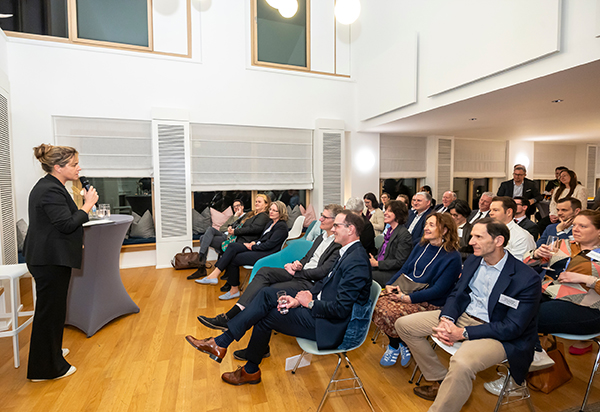
Mona Neubaur, Minister for Economic Affairs of North Rhine-Westphalia, spoke at the OECD dinner in Münster
The fact that a healthy environment is, in any case, the prerequisite for everything else was already understood by those who gave its name to the twelfth-largest US state. In the language of the Dakota Sioux, Minnesota means ‘clear water’.
Image credits: image 1: Adobe Stock: © Billy McDonald; image 2: © IHK Nord Westfalen