

The swallows and robins are singing, the crocuses and daffodils are flowering, the first warm rays of the sun are on our faces. Spring is in the air – prompting many of us to begin one of our annual rituals: to clear out our wardrobes. Do those trousers still fit? Is this T-shirt still okay? This is the time when mountains of old garments are exchanged for millions of new clothes.
Over the last few decades, people living in Germany did not need to worry about how to get rid of their old clothes. For many years, unwanted garments were collected quietly and efficiently. Municipal, private sector and charitable organisations collected discarded textiles across the country via the thousands of clothes banks located close to people’s homes. These old clothes then ended up on the second-hand market or were exported for reuse. Anything that was unable to be reused was recycled into cleaning rags or insulation material – or incinerated to produce energy.
And, for the most part, the old clothes market continues to operate like this. The war in Ukraine and cheap fast fashion have, however, greatly changed the framework conditions. New clothes are so cheap that the second-hand business has collapsed in many of the importing countries. Over the last few months, this has led to many commercial and charitable organisations stopping their collections altogether as the business model used in the old textiles market continues to be based on the premise of being able to sell reusable clothes.
This has been exacerbated by the fact that the volume of garments being discarded has also grown considerably. According to the European Environment Agency (EEA), Europeans consumed, on average, 19 kilograms of textiles in 2022 – this figure lay at 17 kilograms in 2019. With Europe home to 450 million people, a two-kilogram increase means that the volumes of old textiles grew by around one million tonnes across Europe.
The different ways Germany’s old garments are processed
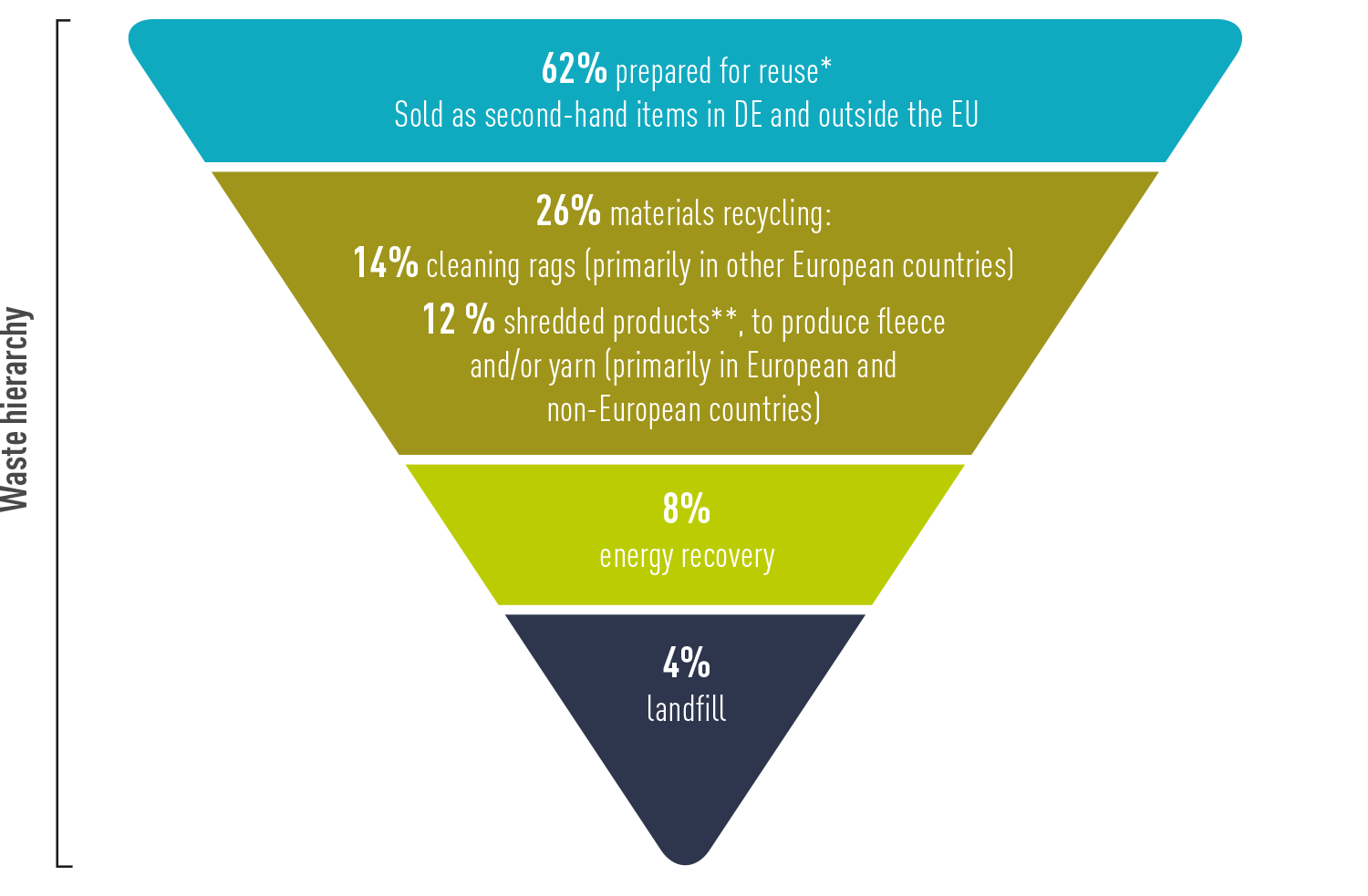
Source: Oeko-Institut, data from Wagner et al. (2022)
* not all of the 62% sold as second-hand items are reused; a considerable portion is used differently in the importing countries, e.g. they are recycled (materials recycling or energy recovery) or sent to landfill
** shredded products are made by mechanically tearing up the textiles into fibres
The Top 10 exporters of garments worldwide
acc. to export value in 2023 (in billion dollars)
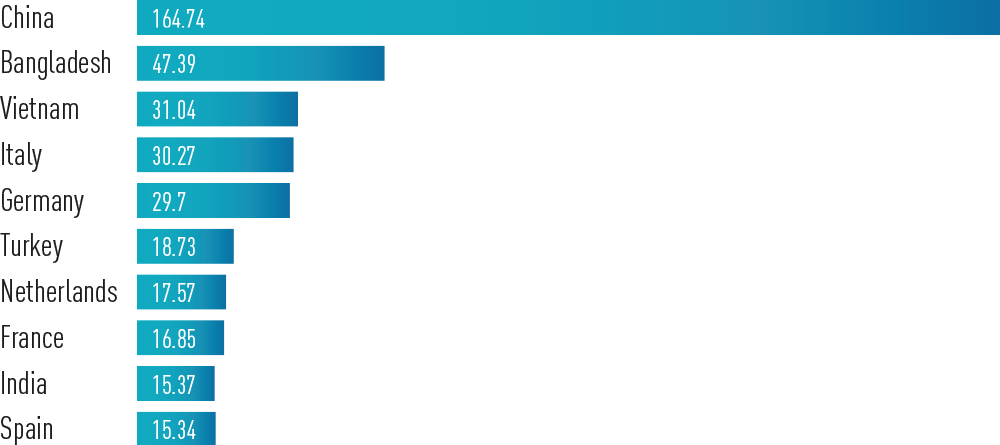
Source: WTO, created with Datawrapper
A circular economy for textiles
The first signs of this development were already noticeable a few years ago. REMONDIS and the Swedish fashion company H&M responded to these by founding the joint venture Looper back in 2023 to ensure that old garments continue to be reused and recycled responsibly in the future as well. Being one of the biggest fashion brands, H&M is also one of the biggest distributors of fashion items in Europe. Back in 2013, it began taking back old clothes in its shops and has so far collected around 172,000 tonnes of garments via this programme.

Looper’s goal is to take over responsibility for textiles and to become a key hub in this circular system. As a result, H&M and REMONDIS wish to help ensure that far more old garments are collected separately than before. At the end of the day, one of the big problems of recycling old textiles is the low collection rate. At present, around just 40% of the fashion items distributed across the European market are collected separately – 60% end up in the general waste bin, which means they are either incinerated or sent to landfill. “While the volumes of old garments continue to grow, far too many of them are still being incinerated or landfilled. The need for robust collection systems and high-quality sorting processes is bigger than ever. Here at Looper, we are building up the infrastructure that is needed to create a well-functioning circular economy in the textile sector as well,” explained Erik Lagerblad, CEO of Looper Textile Co.
Looper is breaking new ground
H&M and REMONDIS are heading down new paths with Looper to close this gap. “People can take their old clothes to any H&M store,” commented Marc Schubert, managing director of Looper in Germany. “It makes no difference what the brand is. The garments just need to be clean.”
Each item that is handed in is checked and sorted by Looper to determine the quality, condition and resale potential.
“65% of the clothes we collect can be reused,” Schubert said, speaking from experience. Looper’s facilities then sort these clothes into more than 200 categories. “This increases the likelihood that a customer will find a suitable second-hand item.” A good sorting process is key to achieving a high reuse rate.

“65% of the clothes we collect can be reused.”
Marc Schubert, Managing Director of Looper
The great potential of fibre-to-fibre recycling
According to Schubert, 23% of the clothes collected by Looper are recycled. “We generally use them to make new products such as cleaning rags or insulation material,” the managing director of Looper in Germany remarked. The proportion of items sent for high-quality fibre-to-fibre recycling is low at Looper as well. Fibre-to-fibre recycling describes the process that sees new fibres being produced from old textiles so that they can be used to produce new garments instead of virgin raw materials. At the moment, however, this highest form of recycling is only used for just two percent of the clothes collected by Looper. “We believe there is a great potential here to grow this share in the future,” said Schubert.
The framework conditions must, however, be right for this because fibre-to-fibre recycling is expensive. A general rule of thumb here is: the cheaper the input material, the more expensive the recycling. One of the reasons why fast fashion manufacturers can offer such inexpensive clothes is because they can save on materials. “For the most part, fast fashion is made of cheap mixed fibres, for example 60% polyester and 40% cotton,” explained Melina Sachtleben from RWTH Aachen University during an interview with RE:VIEWS. A scientist by trade, she works at the Institute for Textile Engineering and knows all about this subject. Polyester is – the clue is in the name – a synthetic fibre that is particularly inexpensive to produce. Other materials such as polyamide and elastane are also added to fast-fashion items to further lower production costs as well as to make the products more elastic and durable.
The technology is there to recycle these mixed fibres, with the most promising recycling process being chemical recycling. Chemical recycling systems can break down these popular polyester-cotton mixtures into their individual constituent parts. The cotton is then processed into cellulose pulp – which can be used to produce rayon – while the polyester is recycled into a new material.
“It makes neither technical nor economic sense to have one recycling process for all textiles.”
Melina Sachtleben, RWTH Aachen University
Melina Sachtleben
Melina Sachtleben MSc is a scientist working at RWTH Aachen University’s Institute for Textile Engineering. Her research work focuses on bioeconomies and textile recycling to develop sustainable solutions for the textile industry. Moreover, she has qualifications in the areas of management and clothing technology and is a certified tailor.
Having worked in the textile producing nations Bangladesh, Indonesia and Tunisia, she has gained in-depth insights into the business – all of which have shaped the way she wishes to promote sustainable textile circularity. Melina Sachtleben has worked in a variety of industrial projects and publicly funded initiatives to develop innovative strategies to make the development, production and use of garments more environmentally friendly.

New collection and sorting schemes for old garments
Having said this, chemical recycling is both energy-intensive and costly and should, therefore, only be used for textiles that cannot be recycled with mechanical processes. “It makes neither technical nor economic sense to have one recycling process for all textiles,” Melina Sachtleben said. This is where the collection and sorting systems come into play: “The organisations collecting and sorting the materials must adapt their schemes to the new recycling methods,” she continued.
With fabrics becoming more complex and second-hand markets more complicated, the collection and sorting of discarded clothes must be adjusted to meet these new conditions so that the material life cycles really can be closed in the future. One option could be to separate old garments into two different categories at source. “Old clothes could have separate collections. One for reusable and one for recyclable old textiles,” commented Sachtleben. She referred to the trials currently being carried out in Denmark that have had a positive impact in this area.
Extended producer responsibility: the costs for collecting, sorting and recycling or disposing of the old garments must be covered by the companies producing and distributing the products.
The best case scenario would be for future garments discarded in Germany to be sorted as Looper is already doing today. This would see the reusable items being sold on the second-hand market and the non-recyclable garments (e.g. soiled functional wear like ski trousers, swimwear and sailing clothes) being sent straight to a waste-to-energy plant. The recyclable garments would then be sorted according to material to ensure they are recycled in the best possible way. The illustration below provides a simplified material flow management chart for old textiles, with the recyclable materials being sorted into mixed fibres, cotton and polyester.
Such a sorting process is, however, expensive. The country currently does not have the right infrastructure to do this for the approx. one million tonnes of old garments discarded every year. Which means it has to be set up first. The recycling industry is not able to cover the costs of doing this as this would not be financially viable under the current market conditions. The costs for collecting, sorting and recycling or disposing of the old garments must be covered by the companies producing and distributing these products to push the market towards selling more durable and more recyclable clothing. The EU has already taken corrective measures here and introduced extended producer responsibility into the textile sector in its amended Waste Framework Directive.
Possible old textile recycling processes with extended producer responsibility
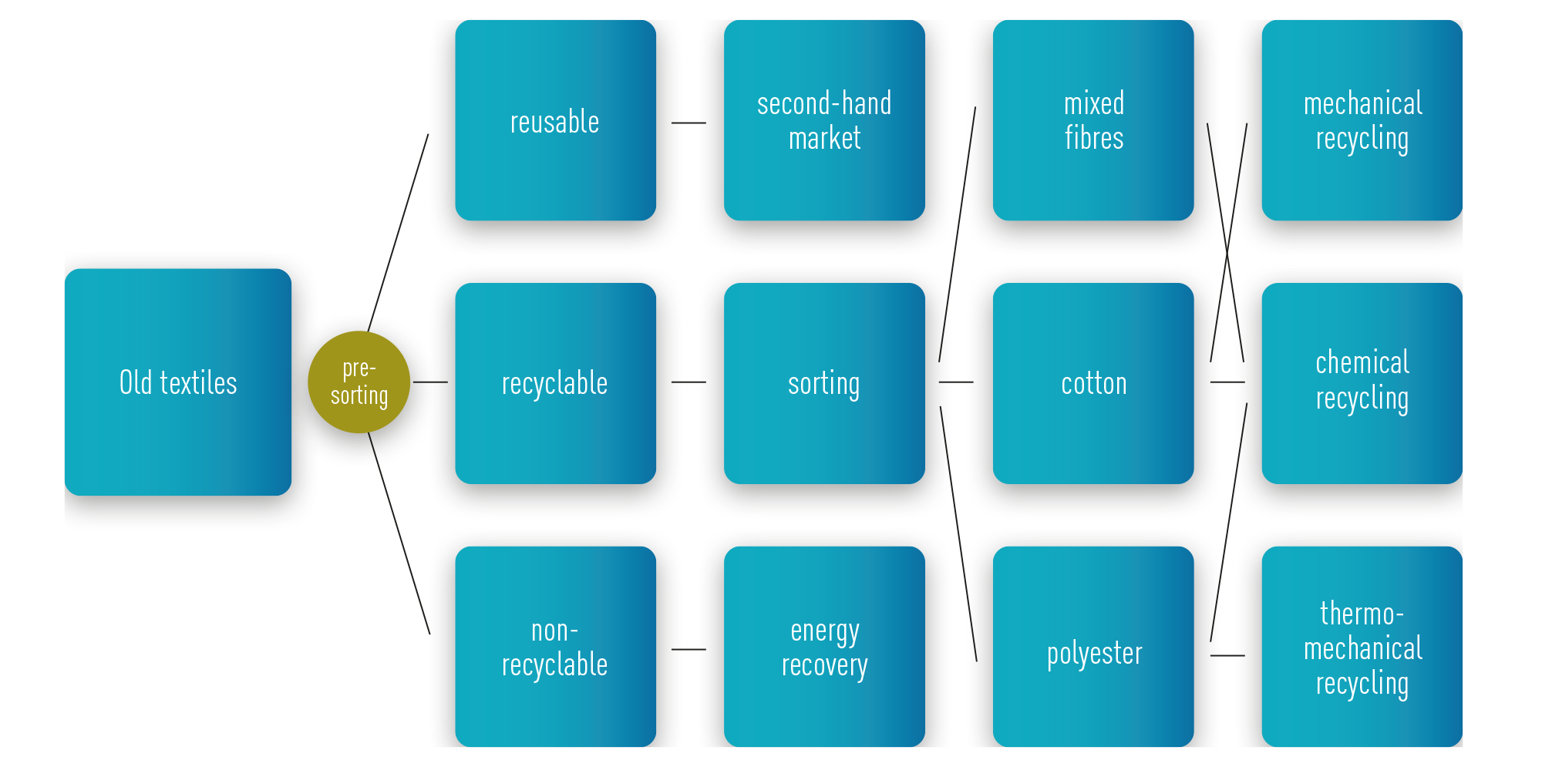
Source: own depiction
The different recycling processes

Mechanical recycling
The mechanical process has the benefits of being less energy-intensive and more cost-efficient and it can also be used to recycle material mixtures. On the other hand, the recycled fibres are often of a lower quality than before, leading to a downcycling of the products as they are turned into, for example, insulation material or painter fleece. In principle, though, fibre-to-fibre recycling can be mechanical.

Thermomechanical recycling
The thermomechanical process is a suitable method for recycling pure polyester fibres as it is a relatively simple and less energy-intensive process. The main restriction here is that the material must contain more than 90% polyester, making it unsuitable for recycling mixed fibres.

Chemical recycling
The main benefit of chemical recycling is its ability to separate mixed fibres, making it possible to produce high-quality recycled raw materials. This method is, however, complex and energy-intensive – and, therefore, costly. Furthermore, the sorting and purity requirements of the input materials are very high. This most expensive type of recycling is, therefore, most suitable for recycling cheaply produced fast-fashion items. The discrepancy between the price of a new garment and the costs of recycling it could hardly be bigger and explains the low levels of fibre-to-fibre recycling in the textile recycling sector.
When put into practice, extended producer responsibility (EPR) is implemented by system operators who act as a kind of ‘belt drive’ between manufacturers and recyclers. Manufacturers pay the system operators a licence fee which they then use to make sure that the waste materials – in this case old garments – are processed in line with all statutory regulations and that all recycling rates are achieved. The EPR system should ensure that the manufacturers cover the costs of collecting, sorting and recycling their textiles, especially in times of fluctuating raw material prices.

On top of this, though, it is also possible to add bonus payments into the EPR levy scheme. “Licence fees can be used like government levies to steer the sector in a specific direction. The EPR licence fees must be lower for easily recyclable products than those for items that are difficult or impossible to recycle,” commented Herwart Wilms, managing director of REMONDIS Service International GmbH, President of FEAD (European Waste Management Association) and chair of Looper’s supervisory board. Experts call this eco-modulation. “Companies that act sustainably must benefit financially,” Wilms continued.
Designing the system in such a way could encourage the textile sector to become more sustainable. At the end of the day, companies need such a reliably financed system if they are to invest in the innovative collection, sorting, processing and recycling capacities that are urgently needed to create a well-functioning circular economy.
When, in a few years’ time, the swallows, robins and storks return home from their wintering grounds, the daffodils and crocuses begin flowering and the sun’s first rays herald the coming of spring, no one in Europe should need worry about what they should do with their old clothes. A well-functioning EPR system will be financing the collection and sorting of their old garments, sending these items to be recycled in the best possible way – and, in the best case, ensuring that the trousers and T-shirts can be worn for a further season.
“Companies that act sustainably must benefit financially.”
Herwart Wilms, REMONDIS Managing Director and FEAD President
What is extended producer responsibility?
An extended producer responsibility (EPR) scheme for textiles effectively sets up a system that makes it obligatory for textile manufacturers to take over responsibility for the whole life cycle of their products – from the collection, reuse and/or recycling of their garments through to the disposal of the non-recyclable leftover materials. Based on the EU’s revised Waste Framework Directive (WFD) – which must be transposed into national law by 17 June 2027 – this measure is looking to achieve a major transition within the sector and drive it towards becoming a circular economy. This EPR scheme must have been implemented by 17 April 2028.
The key objective here is to significantly grow the reuse and recycling of textiles to reduce the sector’s impact on the environment and climate. As a result, manufacturers must enter their business’s details on national registers and contribute financially towards the costs for waste management, information campaigns and research and development. Producer Responsibility Organisations (PROs) take over the responsibility of implementing the manufacturers’ obligations.
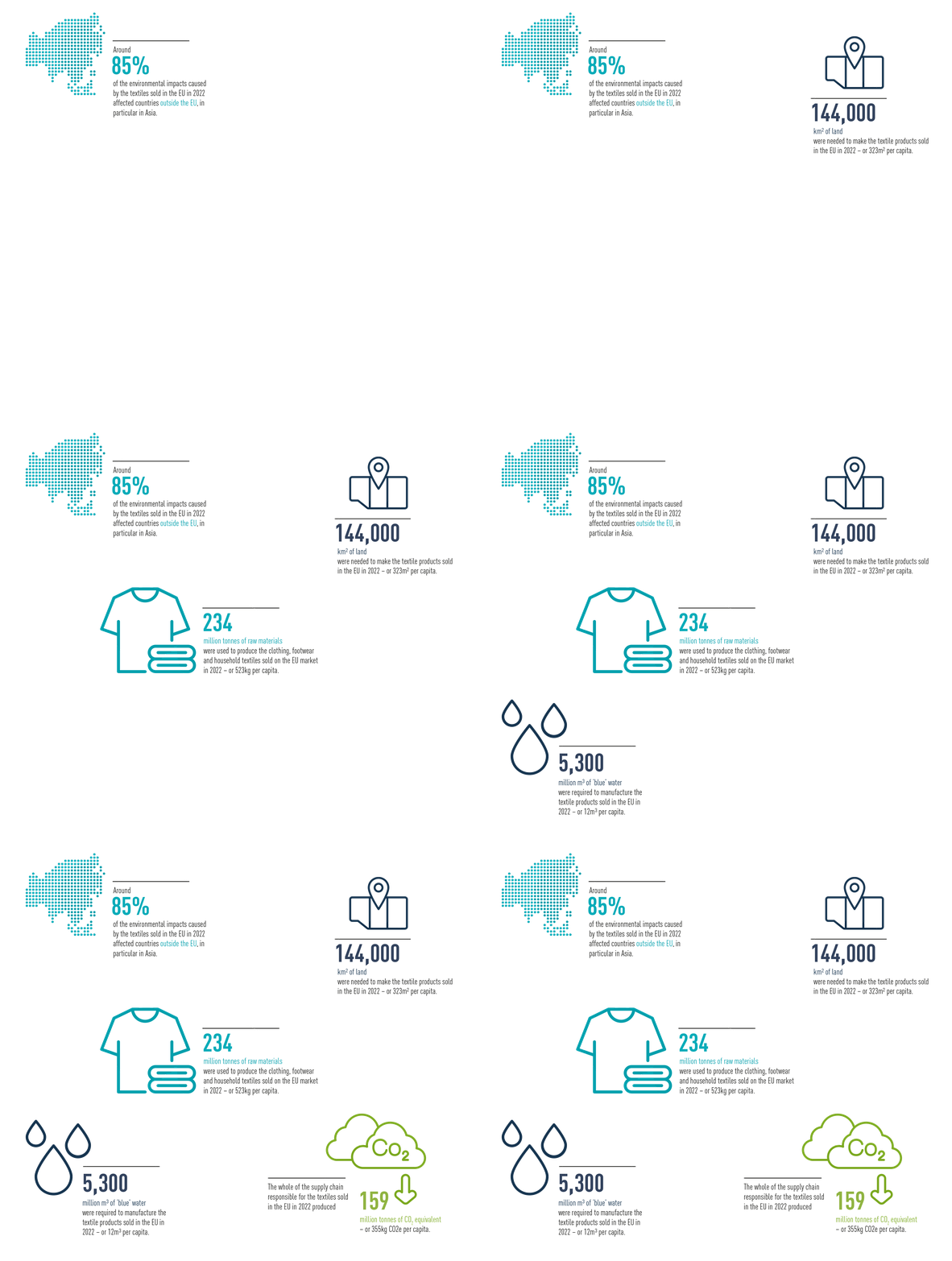
Source: European Environment Agency (EEA)
Image credits: image 1: Adobe Stock: Natart, Adobe Stock: accogliente; image 2, 4: Adobe Stock: accogliente; image 3: Adobe Stock: Aro; image 5, 8: Adobe Stock: oxie99; image 6: Melina Sachtleben; image 7: Adobe Stock: aneduard