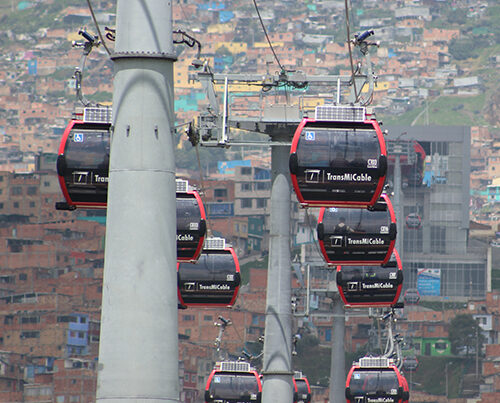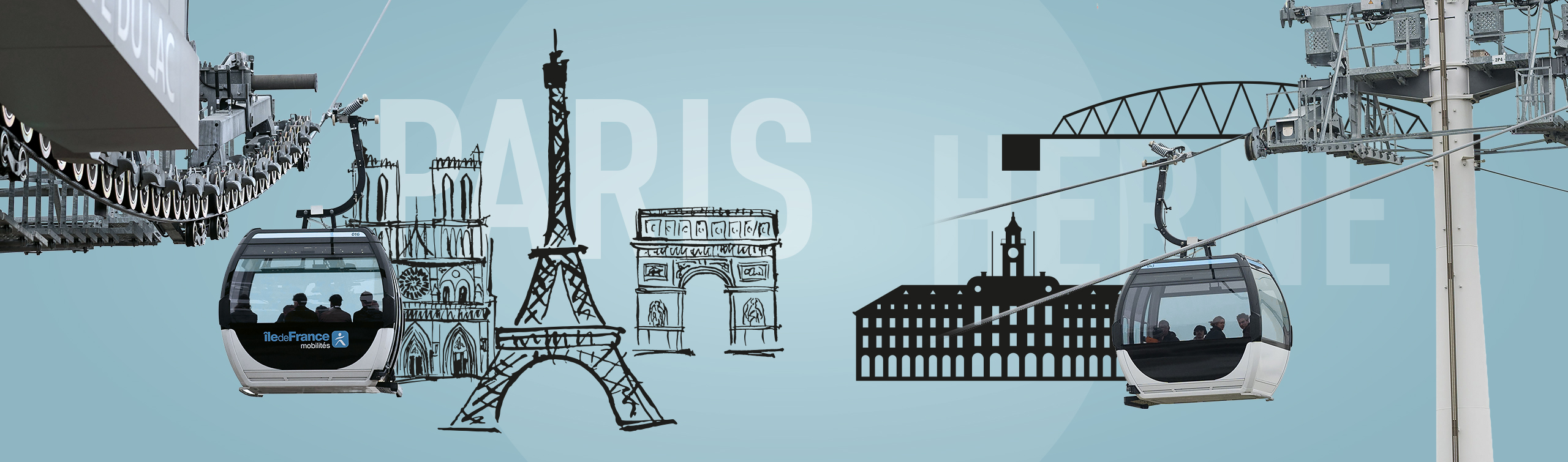

So what do Paris and Herne have in common? More than many may assume – especially if they cast their eyes upwards. At the end of 2025, an urban cable car – the Câble C1 – was added to the French capital’s public transport network. Operated on behalf of the regional transport authorities ‘Île-de-France Mobilités’, it travels above the busy streets and connects several densely built-up districts.
And, at the end of January 2026, a cable car company was founded in Herne (a town situated in Germany’s Ruhr area) to look at the possibility of connecting the Blumenthal development area with the Wanne-Eickel train station. Both plans reflect a similar goal: local authorities wish to offer sustainable, innovative and affordable mobility solutions – and are looking for partners with the right operational, technological and organisational skills to help them.
One of these partners is Transdev, one of the world’s leading privately-run mobility companies. And it is involved in both the Paris and the Herne projects. The firm already operates numerous rail and bus networks in Germany – always on behalf of and under the watchful eyes of their public sector client.
From controller to municipal partner
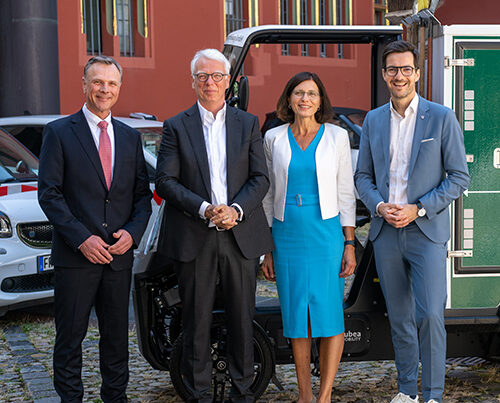
Christian Kleinenhammann works for Transdev Deutschland, where he is spokesperson for the management board, chief operating officer (COO) and work director. His career reflects the close ties between public sector infrastructure and entrepreneurial thinking. After graduating from university, he took up the post of controller at Niederrheinische Verkehrsbetriebe AG (NIAG), a transport firm steeped in tradition and an associate company of the RETHMANN Group. It became clear to him even back then that mobility is much more than just the sum of the routes and vehicles: it is always a collaborative project as well – one involving the local authorities, the local residents and the operators.
This outlook has also shaped the way he has approached his other jobs – as managing director of Transdev Rhine-Ruhr, regional manager North-West and, ultimately, as a member of the management board at Transdev GmbH in Berlin. Today, Kleinenhammann is in charge of the operational business and, together with his fellow management board members, represents the interests of the company vis-à-vis the German government, the individual German states, clients and local authority partners.

“PPPs have nothing to do with privatisation. They are a responsible division of labour.”
Christian Kleinenhammann, Spokesperson for the Management Board, Chief Operating Officer (COO) and Work Director at Transdev Deutschland
The power of partnerships
Transdev is one of the largest private sector providers operating in Germany’s public transport networks. The company does not see itself as being a competitor here but as a partner to the public sector. Public private partnerships (PPPs) – a collaborative system that both the RETHMANN Group and local authorities are very familiar with – can often be found behind many of these networks.
The principle behind such partnerships is clear: the local or regional authority is the client and the body in charge of making the strategic decisions. It determines the timetables, fares, environmental goals and quality standards. Transdev is the operator and ensures these decisions are implemented: with its staff, workshops, vehicles and digital infrastructure.
Examples of such partnerships include the long-standing collaborations with NIAG in the Lower Rhine region, Regionalbus Oberlausitz in Saxony and Taeter Tours in Dresden. And then there are Rheinbus, Habus, Westbus and the new RE Mobility in the District of Unna to name just a few. These models take the pressure off the public purse, secure local jobs and allow individual towns to make the most of know-how they would find hard to access on their own.
“PPPs have nothing to do with privatisation,” Christian Kleinenhammann stressed. “They are a responsible division of labour. The local authorities set the direction and we put it into practice.”
The benefits for local authorities:

They can plan ahead thanks to the long-term contracts & clear responsibilities
They have access to modern operations & fleet management systems
They can offer innovative mobility systems, e.g. on-demand transport & fleets run on alternative fuels
They remain in charge of their public sector task of setting the scheduled services, fares & quality
Mobility’s green transition – on behalf of public sector clients as well
The Transdev Group has a global workforce of around 107,000 employees who convey approx. 14 million passengers every day. An ever-bigger proportion of the company’s fleet is free of emissions being either electric or hydrogen-run. Transdev is increasingly deploying vehicles run on alternative fuels for its public sector clients as well to help them achieve their regional climate goals. Just one example: the company operates the largest fleet of electric buses in Europe.
In addition to this, the company develops on-demand transport systems for rural areas, digital sales platforms, barrier-free ticketing systems and multimodal hubs with connections to other transport services.
“The people using Transdev’s trains and buses have been able to observe how new technologies are gradually becoming part of the everyday service in many areas of the country,” Kleinenhammann explained. “Passengers often won’t see our logo. But the systems they use to book and pay for their tickets and to travel to their destinations are often from our company.”
Transdev – the company
Transdev operates in 19 countries across six continents – from Sweden to Australia, from Columbia to Morocco. Being one of the world’s leading providers of mobility services, the group and its workforce of around 107,000 employees convey approx. 14 million passengers every day. Its annual turnover lies at around ten billion euros.
The company employs approx. 9,000 people in Germany, where it conveys around 200 million passengers a year. Its transport services range from regional and suburban trains, to bus networks, all the way through to on-demand services. The RETHMANN Group has owned a 66% share in the company since 2025, with the French Caisse des Dépôts remaining its strategic partner with its 34% share.

Future fuels: an ever-bigger proportion of Transdev’s fleet is free of emissions being either electric or hydrogen-run. It is increasingly deploying vehicles run on alternative fuels to help its public sector clients achieve their regional climate goals
Cable cars – a part of transport’s green transition
The Paris example shows how well such partnerships work. Câble C1, the first urban cable car in the greater Paris area, opened to the public at the end of 2025. It is being operated by Transdev Coteaux de la Marne on behalf of Île-de-France Mobilités. 4.5 kilometers in length, it connects five stops, is fully accessible and is part of the region’s fare system. Around 11,000 passengers can now travel more quickly from the outer suburbs to the city’s main hubs every day using this quiet, emission-free and space-saving mode of transport.
Several towns in Germany are looking at the possibility of developing similar systems. In Herne, for example, HCR (Straßenbahn Herne – Castrop-Rauxel GmbH) and Transdev GmbH recently founded a joint venture that aims to operate a cable car system in Herne in the future and to develop the grounds of a former coal mine there. This plan shows that innovative transport systems, such as cable cars, could be used in places where other systems are less practical.
“Mobility can only work if it’s seen as a shared task,” Christian Kleinenhammann believes. “Between the client and the operator, between the local authority and the company. This is what is at the very heart of our work and our success.”
Cultural change under the umbrella of a strong family-run group
Transdev is part of the family-run RETHMANN Group, which operates in the recycling, logistics, water management and mobility sectors all around the world with a number of different companies including REMONDIS, Rhenus, SARIA and Transdev. This cooperation work creates cross-sector synergies – from sustainable logistics solutions through to efficient transport models.
Such synergies often lead to a change in the way work tasks and collaborations are structured – both at the public sector clients and the companies. Transdev is actively driving this transition in the mobility sector and is working on making changes within its own company as well: one of its goals is to have made its large German team, which is managed from Berlin, more diverse and more modern by 2028. More women should be working in managerial positions; the number of young managers should increase as well; and there should be greater career opportunities for those providing the transport services. “This transition is teamwork,” said Kleinenhammann describing how they wish to move forward. “We want to show that mobility is a profession for everyone, no matter what their sex, origin or age.”
The Transdev team know, however, that there is one thing that must always be kept in mind to ensure large networks remain on an even keel: namely, being interested in the needs of the local inhabitants. So much more connects Paris and Herne than just a cable.

4.5 kilometers in length, Câble C1 connects five stops, is fully accessible and is part of the region’s fare system.
Christian Kleinenhammann
Spokesperson for the Management Board, Chief Operating Officer (COO) & work director at Transdev Deutschland
After starting his career as a controller at Niederrheinische Verkehrsbetriebe AG (NIAG), an associate company of the Rethmann Group, he took on various managerial and regional roles within the company. He joined the executive management team at Transdev GmbH in Berlin in 2023. In 2025, he took on the additional roles of spokesperson for the management board and work director. Together with his team of colleagues, he is responsible for implementing the company’s operational strategy and collaborating with the public sector clients.
His passion for numbers has remained with him throughout his career, both up to and including his current post as COO of Transdev. At the end of the day, mobility must be both cost-effective and reliable. “But the numbers are just the foundations. People looking to shape mobility nowadays must think outside the box and go beyond simply achieving efficiency. It’s all about quality of life in the towns and rural areas. And it’s about how we can use public spaces more intelligently: cable cars are a wonderful example of a solution that is good for business and good for the environment,” Kleinenhammann concluded.
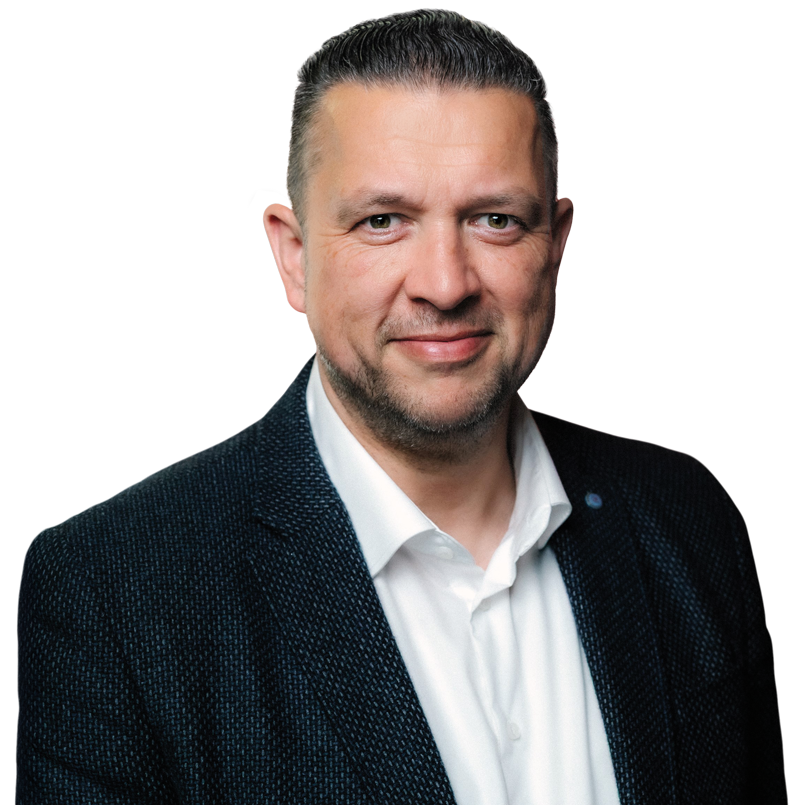
Image credits: image 1: © Transdev, Adobe Stock: Olesia, Adobe Stock: SG- design; image 2, 4: Adobe Stock: Black; image 3, 5: © Transdev