

Having taken the decision to pool together its drain, pipe and sewer operations, REMONDIS has now established a new firm dedicated to offering these services. Its name: AQUA-TOOL GmbH. This new divisional company currently has eight branches across Germany and a workforce of around 275 employees. It also operates a similar number of vehicles to enable it to offer its extensive range of pipe and sewer services – from cleaning, to renovation, to desludging work. It has a wide customer base, serving local authorities and commercial businesses as well as private households. REMONDIS has, therefore, pooled together its activities from its various regional companies and divisions. The new company is based in Lünen and its goal is very ‘REMONDIS’, i.e. to make better use of the existing know-how within the group and to strengthen its internal network in order to organically grow its range of services, in particular those for local authorities.

Björn König, one of the new company’s two managing directors, explained that technology was one of the main drivers behind this decision: “The technology that we use for both our sewer cleaning and our sewer inspection work is incredibly complex. Something that also explains why, for example, our specialist vehicles cost far more than standard refuse collection trucks.” Companies operating in this particular field of business not only have to invest considerable sums of money to keep up with the technical progress being made in the sector and remain competitive. They have also seen a number of firms that manufacture the specialist vehicles they need turn their backs on the market. The aim is, therefore, for AQUA-TOOL to generate added value. Put in concrete terms, it should promote the internal transfer of know-how, ensure the vehicles and equipment are being used to capacity and drive standardisation as well as create advantages when it comes to procuring technical equipment.
Looking ahead, these factors will become even more important as the sector finds itself facing further challenges caused by decarbonisation (think electrification of vehicles here) and the digitisation of its own processes. EVs are not an issue at the moment. At present, batteries are simply not able to deliver the power needed to run the machines installed in the vehicles (e.g. the suction pumps). This has been clearly demonstrated by the first trial vehicles presented by various different manufacturers. With the batteries currently having to be recharged three or four times a day, work schedules are disrupted and processes ground to a halt, Björn König explained. Looking at how fast batteries are being further developed, however, viable solutions are bound to come onto the market soon.
“We believe having our own divisional company has created a strong foundation for us to continue our business in the future as well.”
Martin Slotosz, managing director of AQUA-TOOL
This environment is changing, however, as many of these business owners are heading towards retirement and are having difficulties finding a successor. At the same time, they are unable to put up the money needed to cover the increasing investments or simply no longer wish to invest such sums as the future of their firm is so uncertain. The result: more and more private equity firms are entering the market – and their strategy is consolidation. Something that it is also likely to fuel competition over the coming years. Martin Slotosz, also managing director of AQUA-TOOL, certainly thinks that this will be the case: “We believe having our own divisional company has created a strong foundation for us to continue our business in the future as well.”
Looking at the huge investments that the public sector will have to make in its infrastructure, it can also be assumed that there will be an increase in demand for the services provided by AQUA-TOOL and its competitors. Service providers, such as AQUA-TOOL, not only carry out repair, service and maintenance work but also inspect technical plants and facilities – including inspections that the plant operators are required to have done, in some cases on a regular basis, by law. Many construction projects must have an inspection report drawn up by AQUA-TOOL for their new building(s) to be approved. Another area that falls under the ‘growing demand’ category is the subject of flood risk management and heavy rainfall. At the end of the day, drains and sewers can only cope with the volume of water they were designed for if there are no blockages. As Martin Slotosz sees it, there is still a lack of awareness for this problem at the moment but he also believes that attitudes will change over the medium term.
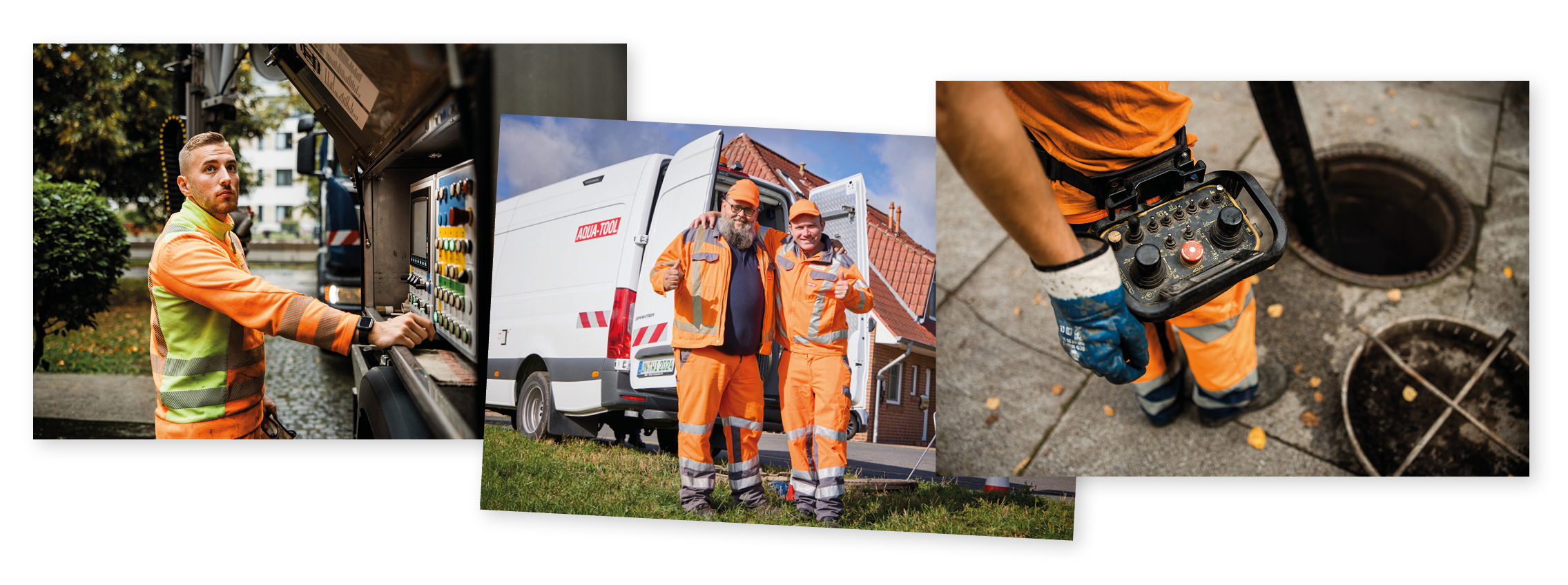
Ultimately, AQUA-TOOL is also looking to grow its workforce and further cement its role as an attractive employer. Having a common personnel development strategy should create greater career and development prospects for its staff. It is not easy to find skilled workers nowadays and the demands, for example, on the drivers are greater than in other sectors. People who are expected to draw up inspection certificates must have received the relevant training and have written proof of their ability to do this work. Six to twelve months are needed before a driver has the skill set required enabling them to travel to a customer on their own. AQUA-TOOL trains its own employees by offering both industrial and commercial apprenticeship courses. And the company also pays for new staff to get their HGV licence when necessary.
AQUA-TOOL GmbH covers seven main service areas: drain, pipe & sewer cleaning, servicing work/emergency services, drain shaft & sewer inspections, renovation work/robotics, pump services, grease traps, cesspit emptying, and desludging work. AQUA-TOOL stands out from its competitors thanks to its wide range of services, its qualified staff and its focus on compliance. This means adhering to all the rules and standards regulating all aspects of the company’s work. For many years, this was something that could not always be relied on in this fragmented industry, creating a difficult competitive environment with some companies taking a more ‘relaxed’ attitude towards the rules and regulations. Things are changing now, however. Companies delivering a professional business and professional services will have a clear competitive advantage in this dynamic market environment with its rapidly changing conditions.
Image credits: © Sprungbrett Medien