
Towns and cities do not have it easy: in most cases, they have too little housing, too many cars, new challenges caused by climate change – and the constant demand to keep streets, parks and pedestrianised areas clean at all times as well as before, during and after small and large events. “Unfortunately, many people no longer feel it is their responsibility to keep public spaces clean. As a result, the volumes and frequency of litter being left carelessly in towns and districts have continued to rise over the last few years,” the authors of the ‘VKU Information 100’ wrote in 2020. This report focused on the subject of littering and the measures being taken by councils to keep their towns clean.
Littering
Litter – be it discarded deliberately or just carelessly – is a subject that all towns and districts are having to cope with.
Most litter tends to be to-go packaging, cigarette ends and plastic bottles.

Dwindling confidence in politicians & authorities
There are more than 2,000 towns and over 8,500 districts in Germany. Many people have noticed that a lack of cleanliness in town districts and local neighbourhoods can lead to local inhabitants losing their confidence and trust in local politicians and authorities and in their ability to deliver key services and find suitable solutions. The Broken Windows Theory – which is not without its critics among social and urban researchers – states that the first signs of anti-social behaviour in a neighbourhood, such as littering, can encourage further negative behaviour. Each town would, therefore, be well advised to take the subject of keeping their towns clean seriously and to take proactive action to prevent litter being left in their public spaces.
Besides the well-being factor and the dwindling confidence in local authorities to be able to deliver services, this is also, quite simply, a question of protecting the environment. Litter left in parks and squares, ponds and lakes, recreational areas and city centres harms the local flora and fauna and has a – potentially long-term – negative impact on local habitats. Most litter tends to be to-go packaging, cigarette ends and plastic bottles. Many of these materials need decades or centuries to degrade and certain polymer compounds even need up to 2,000 years – polluting the environment throughout this incredibly long period of time.

For cleaner cities: the advances made in digitisation have created products that work together hand in hand and provide tangible support for local authorities, helping them to carry out their everyday tasks.
“The harmful substances that are added to products, such as plasticisers, can be released into the environment as the product degrades and the rubbish can also end up in our lakes and rivers and, ultimately, in our seas and oceans,” the UBA [Federal Environment Agency] wrote in its final report ‘Status Quo, Potential Actions, Instruments and Measures to Reduce Littering’ in 2020.
Getting the problem of litter under control with laws, fines and awareness campaigns has not had the desired effect for years now. At the same time, local authorities and public sector waste management companies are despairing at the huge financial and personnel costs involved in having to keep their towns clean.
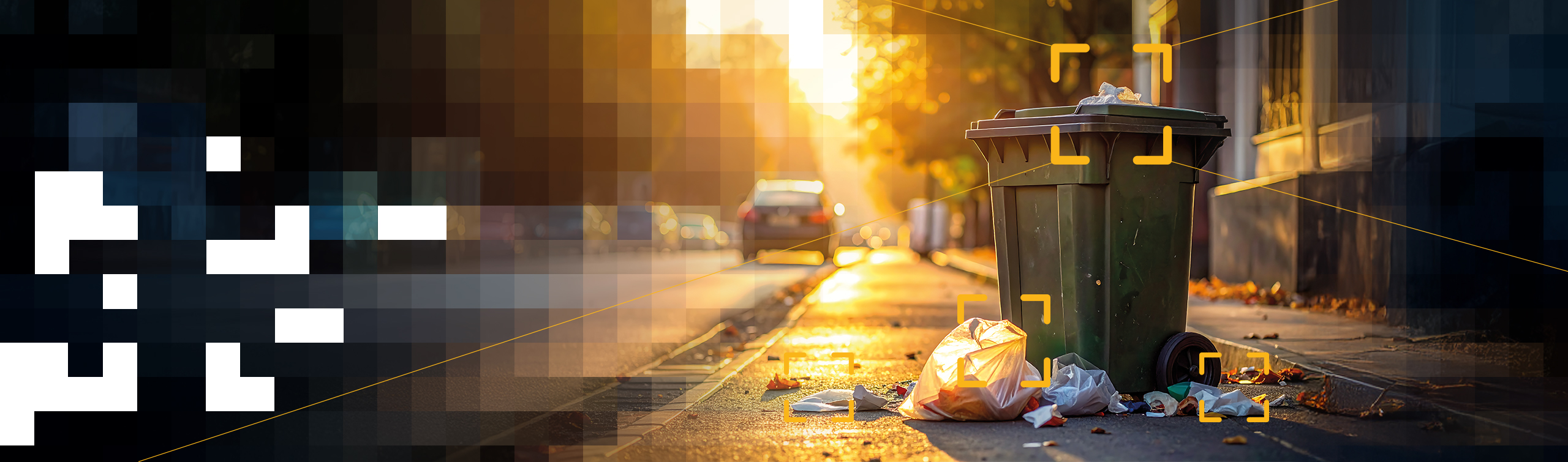
Fortunately, though, there is light on the horizon. The advances made in digitisation have created digital solutions and products that work together hand in hand and provide tangible support for local authorities, helping them to carry out their everyday tasks – and without making their staff obsolete. Quite the opposite in fact. These solutions include REMONDIS Digital’s AI-based application DATAFLEET, a combination of hardware and software, and its comprehensive NEOS digital tool. The DATAFLEET hardware comprises a camera and an edge device, a small computing unit that processes and analyses the data using AI. This high-performance module has been specifically trained with more than four million image data so that it can, for example, identify fly-tipping and litter – certainly not a straightforward task.
NEOS (a German acronym for ‘sustainable, efficient and optimised town cleanliness’) is an all-in-one solution that pools together all the digital functions, such as order management, smart route planning and other external and internal data on town cleanliness. This digital offering completes the AI-based CORTEXIA system, which documents the cleanliness levels of roads, paths and public areas in real time and depicts these in a so-called ‘clean city index’. It records cigarette ends, paper litter and discarded packaging. The findings help those responsible to precisely plan and efficiently manage the individual clean-up jobs.
Using digital solutions, therefore, helps to save resources, increase transparency and make planning processes more efficient. Towns like Potsdam, Hamburg, Mülheim an der Ruhr, Hagen and Duisburg are using REMONDIS Digital’s solutions in very different ways, having adapted them to meet their local requirements and conditions.

Mülheim: doing one thing without giving up the other
“As far as we are concerned, the digital solutions we deploy are primarily there to supplement the measures that we already actively use to keep Mülheim clean,” explained Jennifer Ebbers, press spokesperson at Mülheimer Entsorgungsgesellschaft mbH (MEG). MEG has been using the NEOS platform and automated data recording system DATAFLEET for a while now to locate litter in the town’s public spaces. “The first time we used it was quite spectacular – seven collection vehicles were equipped with cameras and sent out to cover the whole of the town,” reported Janina Müller, the person in charge of MHSB, a mobile unit responsible for keeping the town clean and providing advice to local residents. “Of course,” she stressed, “we comply with data protection regulations and do not take pictures of people. Vehicle number plates are also pixelated. We only record the litter.”
MHSB works at MEG on behalf of Mülheim town council to ensure the town remains clean. Working in shifts, the teams – which consist of an MEG employee and an external security guard – act as a kind of ‘special task force’ for tackling fly-tipping and littering. Their goal is to deter litterbugs and grow awareness about the importance of keeping the town clean.
To achieve this, they make the most of their observation skills, determine who has been fly-tipping and/or littering and, of course, inform and advise. “If this doesn’t work, then the town’s public order office also issues fixed penalty notices,” Janina Müller continued. The average fine is around 160 euros per offence but this can occasionally rise to 10,000 euros in extreme cases of environmental pollution. The levels of cleanliness around the town have improved although there are still a few hotspots that stand out. At the end of the day, keeping towns clean is a never-ending task. And so the technical support has come at just the right time. Thanks to DATAFLEET’s eyes and NEOS’s data, the MHSB teams can work in an even more targeted way – promoting a clean and attractive Mülheim, this town on the Ruhr river.
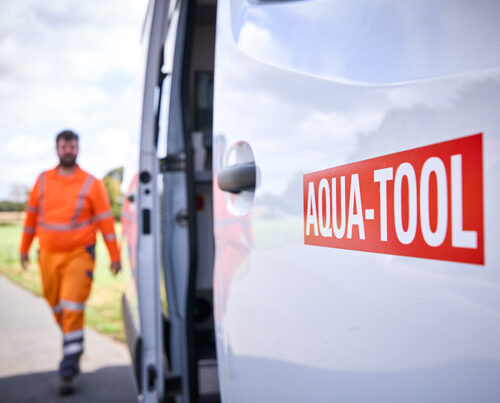
MEG uses automated data recording systems to locate litter in the town’s public spaces.
“As far as we are concerned, the digital solutions we deploy are primarily there to supplement the measures that we already actively use to keep Mülheim clean.”
Jennifer Ebbers, Press Spokesperson at Mülheimer Entsorgungsgesellschaft mbH (MEG)

Hagen: measurable improvements thanks to rapid responses
Speed and precision are the words that come to mind when Hagener Entsorgungsbetrieb (HEB) thinks about this digital technology. “We’ve been using DATAFLEET and NEOS since October 2024,” reported Nicole Flocco, who works at HEB’s administrative office in charge of corporate strategy and development, project management and IT. To begin with, the town had cameras on three of its collection vehicles while the technology was being piloted but all of their 13 collection vehicles are now using them. Furthermore, like Mülheim an der Ruhr, Hagen also deploys the CORTEXIA system, which is primarily needed to objectify information about the town’s cleanliness as well as to monitor and manage the measures implemented.
The town has its own dedicated hotline, which local residents can use to inform the authorities about problems in their areas, such as fly-tipping. Even though this works well, it is no longer enough on its own to solve this problem. “It’s not always clear exactly where the fly-tips are located and so we have to spend a lot of time to find out where the rubbish has been dumped,” Nicole Flocco explained. DATAFLEET’s AI-based cameras now deliver precise and usable information, pinpointing exactly where the litter is and, above all, enabling the team to react quickly. What’s more, this system has also located fly-tips that have not been reported on by local residents.

Besides deploying data-based applications, towns will also need to carry out other measures in the future, whether they be awareness campaigns, community-building events (such as litter-picking days) or environmental education campaigns that begin with the youngest members of society.
This technology is also an additional aid for the team of waste watchers, who have been tracking down litterbugs in Hagen since 2019. There are currently 23 waste watchers working for HEB and the town council; just under 1,400 warnings and fines were issued in 2024 alone. “Using this digital technology also means fewer patrols for our waste watchers, which helps take the pressure off them,” Nicole Flocco was pleased to report. Information about fly-tips and litter is sent straight to the waste watchers’ mobiles via the NEOS software so that they can take immediate action as well as provide digital feedback. DATAFLEET and NEOS help increase their local presence across the town.
Jens Steinbach, head of the waste watcher operations, believes that speed is of the essence here. Illegal waste dumps must be spotted and removed as quickly as possible: “Rubbish attracts more rubbish,” commented this experienced operations manager, “which is why we must be faster than our local residents.” Jens Steinbach is happy to be able to use these digital solutions: “My colleagues are also pleased that they have this digital support,” he continued.
The fact that using this technology has also driven forward the digitisation process within the company is an added bonus as far as he is concerned. This means, he said, that sustainable digital processes can be set up, the green transition achieved and cleanliness levels in Hagen – the gateway to Germany’s Sauerland region – further optimised.
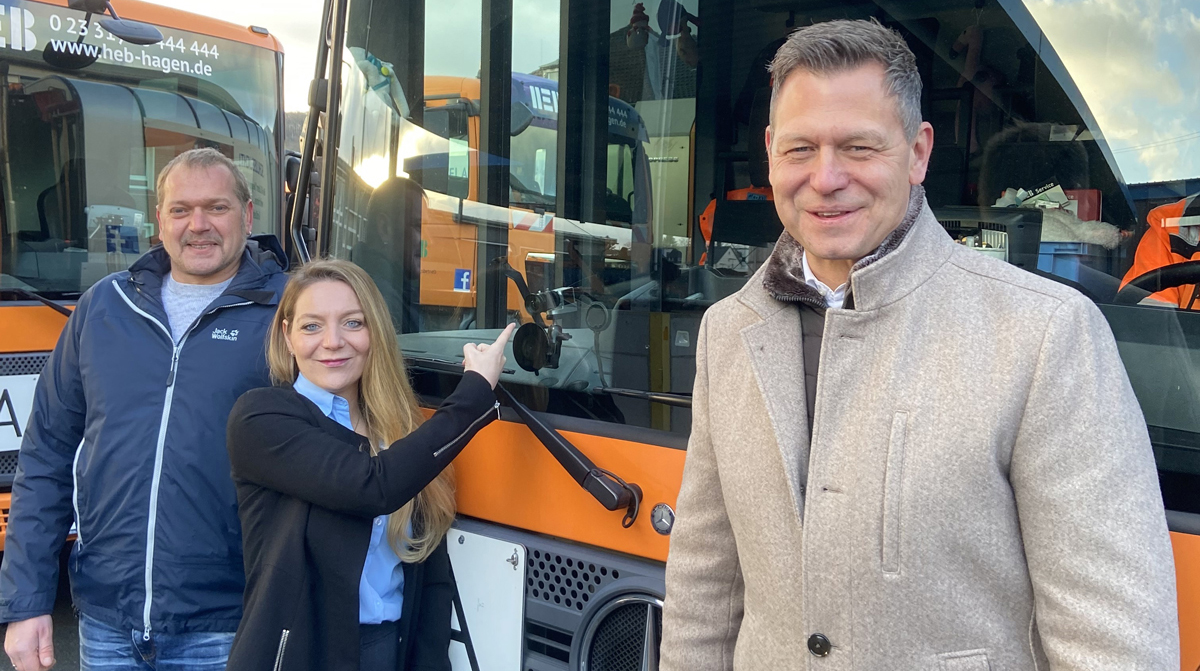
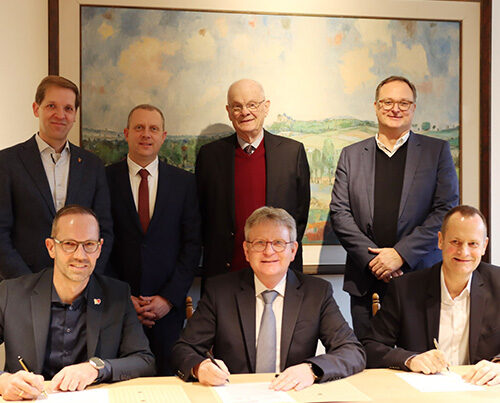
Happy with the digital support in Hagen (from left to right): Operations Manager Jens Steinbach, Project Manager Nicole Flocco, Managing Director Sven Lindemann

Duisburg: it all began with road signs
Town cleanliness is a topic that all towns and cities must deal with, as is the issue of digitising their processes. Switching traditional analogue procedures over to digital ones is, however, a major challenge. “We initially used DATAFLEET and NEOS to locate dirty and/or damaged road signs so that we could take targeted action,” explained Jessica Richter from the traffic control department at Wirtschaftsbetriebe Duisburg (WBD). Artificial intelligence enables such signs to be identified as the refuse collection vehicles drive past them. “That gives us an advantage as we don’t have to wait until someone reports them. We can be proactive,” Jessica Richter continued. The first action, therefore, was to start a sign-cleaning campaign.
Six vehicles operated by WBD’s subsidiary Kreislaufwirtschaft Duisburg GmbH have been equipped with the camera-based, AI-system DATAFLEET since the middle of 2024. As they travel through Marxloh, Meiderich and Mündelheim, they automatically record the traffic signs on the side of the roads – a mammoth task as there are 1,389 kilometres of roads in these three districts as well as squares and paths, 155 bridges and six tunnels. Duisburg’s immense road network has an incredible 70,000 road signs, all of which need to be checked. What better way to do this than with the municipal collection vehicles that regularly travel up and down the roads? Once the signs have been recorded by the DATAFLEET cameras, the data is analysed using AI and then sent to the NEOS platform.
This project in Duisburg helps to keep the town clean, to improve road safety – and, almost incidentally, to enable processes to be managed more efficiently. Jessica Richter summed up the situation saying: “This has been a good start – also as a means to digitise other processes.” Something that will also help further improve Duisburg’s overall appearance as well of course!
CONCLUSION
No two towns are the same; smart digitisation, however, can almost always add value to municipal operations and be a key component helping municipal waste management firms to carry out their tasks. Besides deploying data-based applications, such as DATAFLEET, NEOS and CORTEXIA, towns will also need to carry out other measures in the future, whether they be awareness campaigns, community-building events (such as litter-picking days) or environmental education campaigns that begin with the youngest members of society. At the end of the day, towns will only succeed in remaining clean long term if as many people in their local community as possible join in, now and in the future. And then people’s confidence in local politicians and authorities will also improve!

“This has been a good start – also as a means to digitise other processes.”
Jessica Richter, Head of the Traffic Control Department at Wirtschaftsbetriebe Duisburg (WBD)
Image credits: image 1: Adobe Stock: jodi; image: 2: © REMONDIS Digital; image 3: © MEG; image 4: © HEB; image 5: © WBD