

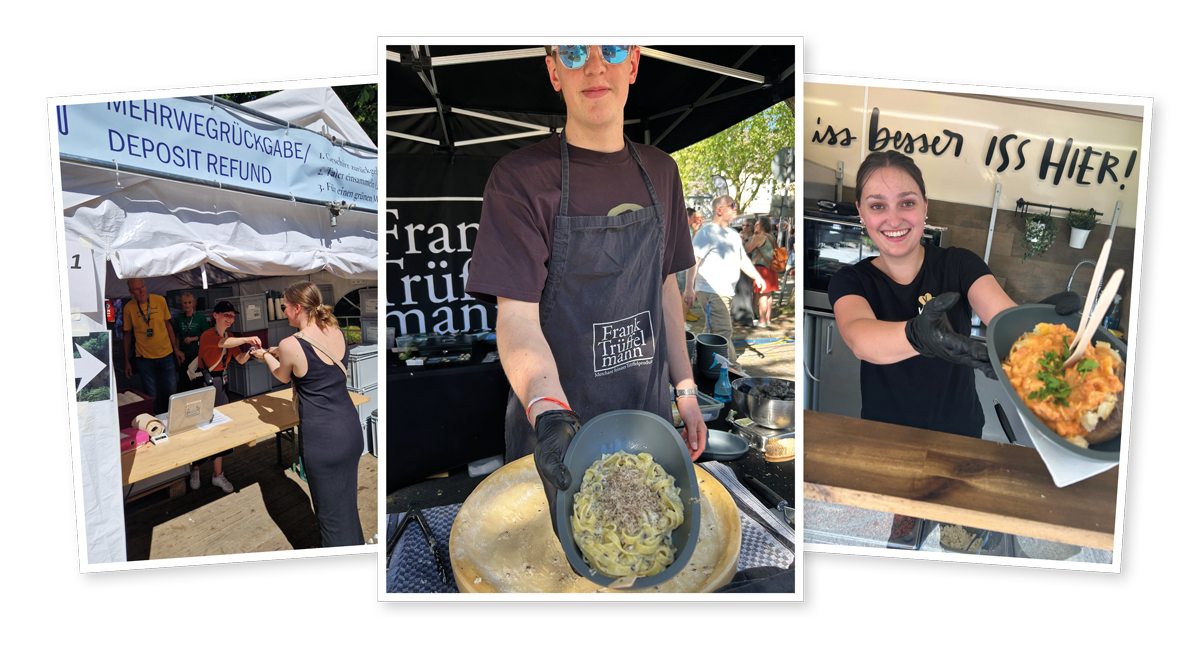
A five-day-long festival, thousands of visitors, countless portions of pulled beef, Cameroon specialities, pasta, and coffee from Ecuador – and hardly any rubbish at the end of it all. What may sound like wishful thinking was what actually happened at the 2026 Moers Festival, which was held from 21 to 25 May. The restaurant owners running their food stalls at the Kastellplatz and neighbouring ‘Festival Village’ only used reusable crockery to hand out their food and drinks. This was all made possible thanks to Moers Kultur GmbH, ES Event-Service Niederrhein, REMONDIS and the Moers-based infrastructure service provider ENNI. And all of it was voluntary – there was not a single legal requirement.
“The bowls, which are all the same, are handed in at various collection points so they can be recycled later. It’s a really good idea that no-one has to use their own bowls.”
Thomas Killy, gastronomer
Jazz, sun and clean plates
The world’s oldest jazz festival travelled to Moers city centre for the first time this year. The main stage was set up on the Kastellplatz, one of the city’s main squares, and the castle gardens were turned into the ‘Festival Village’. The weather was perfect; more than 2,000 tickets were sold. This festival has been held in Moers – Germany’s smallest large city with just over 100,000 inhabitants – since 1972. The Moers Festival also decided to try out a new concept for the plates, cups and glasses used at the event this year: the people were served food from the stalls using reusable bowls for a two-euro deposit. They could then hand back the bowls at a central point run by the event organisers. Thomas Killy, who has run a food stall at the festival for 30 years now, summed the situation up perfectly during an interview with the local newspaper NRZ:
“The bowls, which are all the same, are handed in at various collection points so they can be recycled later. It’s a really good idea that no-one has to use their own bowls.” A two-euro deposit that is good for the environment. There was a great atmosphere at the festival. Stall holder Desiree Mahop, who sells dishes from Cameroon with her family, raved about the visitors during her interviews with the reporters: “The people are so relaxed, happy and friendly.” Anyone who knows this festival market also knows that using reusable plates and bowls fits in perfectly with this event. People notice if they are not there –not when they are being used.

Voluntary – and not simply by chance
Unlike Düsseldorf, a city just 30 kilometres down the road whose waste management by-laws mandate the use of reusable plates and cups at all public events, the Moers Festival decided to introduce this system simply because they believed in it. This was also made possible thanks to the financial support provided by the municipal utilities provider ENNI.
The reusable bowls and plates were handed back to the event organisers at central collection points unlike the system in Düsseldorf where they are handed back to the individual food stalls. Two different concepts, the same result: the crockery is handed back, there is no rubbish to be dealt with.
Reusable bowls and plates for food – still a new idea but one that is gathering pace
It has been normal to use reusable cups at events for many years now. This is not the case, however, when it comes to food: many towns around the country are in the process of setting up solutions in this area. And this is the area that Johannes Hatting and Roland Lenders from REMONDIS Resource Management GmbH are targeting. Once again, they were able to show how far they have developed this business concept at the Moers Festival.
“Both events clearly demonstrated that using reusable plates and bowls for serving food is not a logistics problem at all and this was something that was really welcomed by the visitors,” Hatting and Lenders explained. “Having such a system is no longer an obstacle but a sign of high-quality, modern event planning.”
REMONDIS was not only at the Moers Festival on 23 May but at the Japan Day in Düsseldorf as well where their work was carried out in line with the city’s waste management by-laws. Both events provided the hundreds of thousands of visitors with reusable plates and cups for their food and drinks.

The Düsseldorf model – a blueprint for other cities
Working together with the local waste management company AWISTA, REMONDIS has spent years setting up a system that became mandatory for large events being held in Düsseldorf in 2024: a system where the stall holders can collect and hand back reusable plates and cups from central distribution points.
REMONDIS is in charge of providing and washing the cups and plates as well as for the logistics; AWISTA is responsible for contacting the event organisers and restaurant businesses. “We can offer a full package of services with our partner REMONDIS,” explained Giann-Luca Maßmann from AWISTA. The result: rather than having a patchwork of different schemes, there is a uniform system for all stalls, all dishes, all visitors.
One of the key messages coming from the Moers Festival is that this system can also work outside Düsseldorf and without having to pass new laws. Roland Lenders reiterated this message: “Düsseldorf is spearheading the way compared to other towns and cities. We hope that this great example will encourage further local authorities to adopt similar concepts.” Moers decided not to wait until an amendment to the city’s by-laws made such a move mandatory – and it is this fact that makes the difference.
Hatting and Lenders are looking forward to working with event organisers to introduce such schemes. Anyone planning their next event will find REMONDIS to be a very experienced partner. From the cups to the plates!
In this brand story, we’ve shown how the city of Düsseldorf has embraced reusable solutions.
Image credits: image 1: Adobe Stock: Bonsales; image 2, 3, 4: © REMONDIS; image 5: Adobe Stock: piyaset, Adobe Stock: Diana