

Over 300 guests from the worlds of politics, science & business
“Human capital and leadership skills – Training as a resource.” This was the motto of this year’s REMONDIS Forum, which was held in the German City of Goslar to mark the 20 years’ collaboration work between the city authorities and REMONDIS Aqua’s subsidiary, EURAWASSER. Over 300 guests from the worlds of politics, science and business accepted REMONDIS Aqua’s invitation and attended the event, which took place this September, to take a close look at and discuss the potential performance of today’s workforce and how training and education can impact on this.

Focus on leadership
The forum centred around the speeches given by a number of distinguished guests who talked, for example, about the latest challenges managers have to face as a result of the rapid technological progress being made and demographic change. The audience was first welcomed to Goslar by Andreas Bankamp, managing director of REMONDIS Aqua, Dr Oliver Junk, Lord Mayor of Goslar, and Gerhard Lenz, director of the World Heritage Site Rammelsberg. Urs Meier, the retired FIFA referee from Switzerland, then stepped up to the podium to kick off the proceedings.
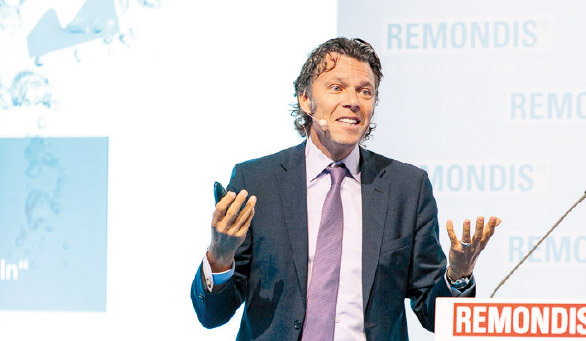
One of the speakers this year: former FIFA referee Urs Meier
Using some entertaining anecdotes from his time on the football pitch as a referee, he had no difficulty in getting his message across to all those present: managers must not only be able to blow a whistle but must also be able to make decisions – because they are the ones that must take over responsibility.
A look back with Norbert Rethmann
One very successful decision-maker, the honorary chairman of the supervisory board of the RETHMANN Group Norbert Rethmann, agreed with everything that Urs Meier had to say. During his speech, he took a look back at the decisions he had had to make to grow his family-run business. Not long after he had taken over his parents’ haulage business, he began asking himself a number of questions: ‘Isn’t waste far too valuable to be simply dumped in landfills?’ and ‘Doesn’t waste impact negatively on our environment if it remains untreated?’ Nowadays, practically all kinds of residual materials can be and are recycled by the RETHMANN Group companies.
The recycling industry is becoming ever more important
Its subsidiary, Saria, even recycles fish and abattoir waste, recovering important substances for the cosmetics and pharmaceutical industries. Heparin, for example, is produced from pig intestines – an important substance for preventing the coagulation of the blood. “Waste materials, no matter what kind they may be, are the raw materials of the future. The importance of the recycling industry will overtake that of the chemicals or automobile industries within the next decade,” commented Norbert Rethmann during his speech at the REMONDIS Forum in Goslar.
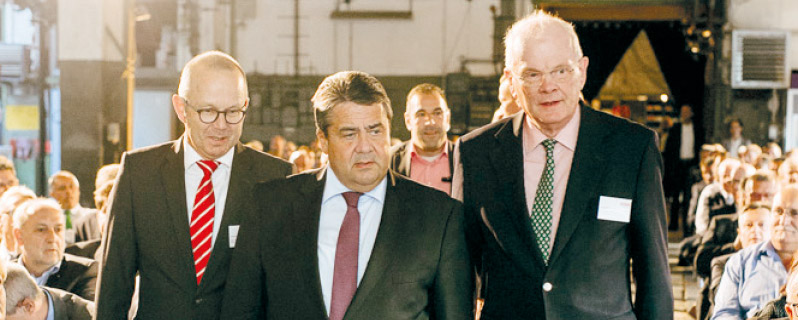
Andreas Bankamp, Managing Director REMONDIS Aqua, Sigmar Gabriel, Federal Minister for Economic Affairs, and Norbert Rethmann, Honorary Chairman of the Supervisory Board of the RETHMANN Group, stand for responsibility and management expertise
A humorous look at IT
Tobias Schrödel followed this with a humorous look at a very new kind of management: “Hacking for Managers – a different approach to IT security”. Here, he described the world of hackers, explaining all about their IT ‘chest of poisons’ and pointing out security loopholes in a most entertaining way. Cracking passwords in no time at all, publishing home addresses and supposedly discredited information – the audience was fascinated and shocked by what he had to say.
Sigmar Gabriel on the rostrum
Next at the podium was Federal Minister Sigmar Gabriel who held a talk about demographic change and promoting integration. The leader of the SPD party presented some telling figures: whilst Germany’s current workforce consists of 50 million people, this figure will have dropped to just 43.5 million by 2030. The country’s population will, in all probability, have fallen from 82 million to 73 million by 2060.
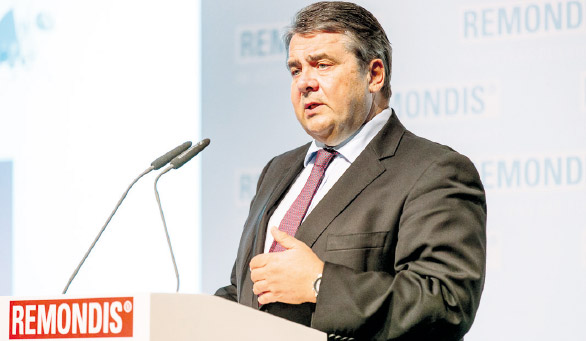
Sigmar Gabriel, Federal Minister for Economic Affairs, talked about a number of subjects including integration and how to provide people with the support they need
Whilst Germany’s current workforce consists of 50 million people, this figure will have dropped to just 43.5 million by 2030.
It is, therefore, essential that the country responds to this extremely rapid demographic change and ensure that the refugees arriving in Germany are successfully integrated into society. What is essential here is having a strong and well-functioning economy and having parliament draw up the necessary conditions to enable this to happen, Sigmar Gabriel explained.
The country’s population will, in all probability, have fallen from 82 million to 73 million by 2060.
Emphasis must not be put on saving money but on investing it. He also had a clear message for the refugees: “Integration is hard work. We must prevent parallel societies from developing around the country”. Those seeking political asylum in Germany need our support but they must also step up to the mark, too. “Immigration must be seen as an opportunity,” Sigmar Gabriel continued. People who travel to Germany to escape poverty and hardship must not be ostracised but must be allowed to join in and become part of our society. However, realism is just as important as optimism. “Demographic change – coupled with the current immigration levels – is one of the largest experiments that an industrialised nation has ever had to face.”
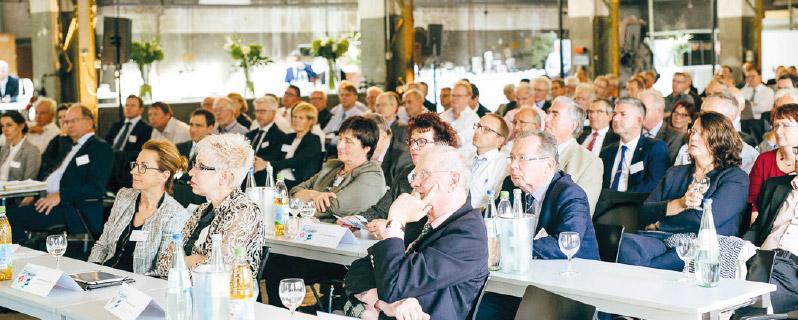
Over 300 guests attended this year’s REMONDIS Forum
Image credits: @Remondis