


A controversial discussion
The debate over the usefulness of community and private cooperative ventures, so-called public-private partnerships (PPP), has been raging for years. Especially in times when municipalities face major challenges, but also considerable uncertainty vis-à-vis the private economy, it is advisable to analyse the topic in a rational manner. After all, what really matters is the answer to the question: can municipalities increase the wealth of the community through public-private partnerships?
PPPs are practically everywhere
Examples of public-private partnerships can be found in almost all walks of life in our society. Be it in schools or child-care centres, in the construction of a new section of motorway, in the construction and operation of nursing homes, in the supply of energy and water or the collection and treatment of waste and sewage – in all of these areas services are being performed in public-private partnerships. Even the most important national standards organisation, DIN e.V., has been a public-private partnership since 1975. It is responsible, for instance, for all standards being set in the public interest.
Public perception of public-private partnerships is as wide-ranging as their areas of work. While advocates are fond of citing the economic successes of these joint ventures, the media is increasingly propagating a negative picture of PPPs. Why is this so? Lack of information is no doubt one reason, technical sloppiness another.

Numerous examples of successful PPP models and their advantages both for public and private partners are discussed at length in our > special PPP issue
[Only German]
Public-sector motives
For municipal partners, there are numerous reasons favouring a PPP: The resources of private enterprises can be used for public tasks, while the risk is split up in investment decisions, the use of market and competitive structures or also the advantage of tasks being efficiently performed in a reliable, economical manner can serve as the motive for founding a PPP. Another positive effect is that the financial resources of municipalities that are recuperated through PPPs translate into greater options in the pursuit of other strategic objectives. Often, the possibility of securing stable fees serves as the sole aim of a public-private partnership.
Another aspect in the motives for a municipality is the ability to select between a contractual or an institutional PPP.
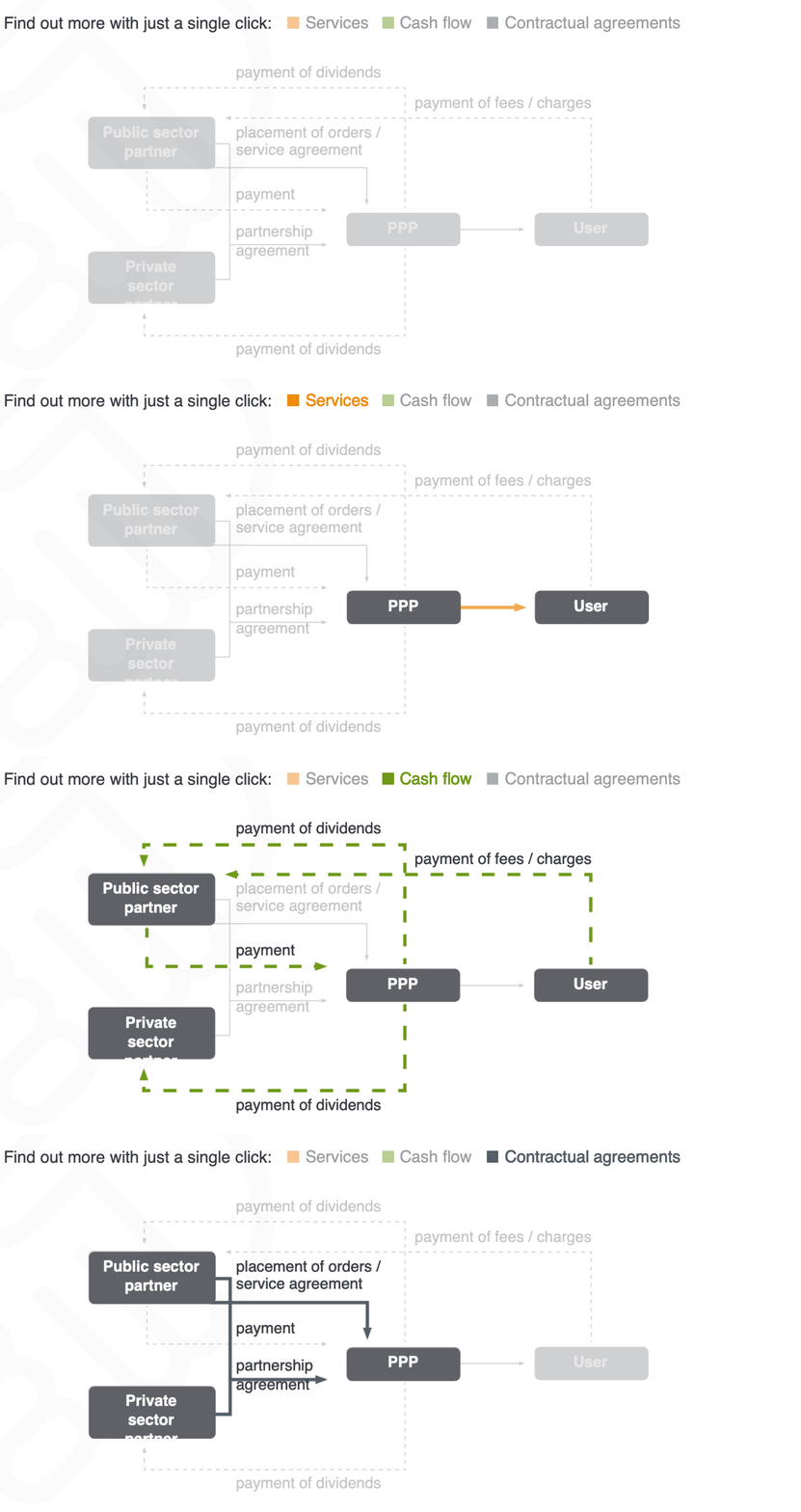
The first model is based exclusively on a contractual relationship between the partners such as is the case, for example, in a concession model. The structure of the agreement or controls on adherence to the agreement are the sole possibility under this model for the municipality to stipulate its desires regarding the service to be rendered and successful execution. One has to weigh out the interest in catching up with overdue investments and hence an improvement in the infrastructure against future obligations to effect payments to the private partner.
The institutional PPP model
What is essential is having the right partner
The model for the institutional PPP is based on the founding of a joint economic structure or the involvement of a private partner in an existing enterprise. This ensures that the public sector, which generally keeps the majority of shares in the company, is able to retain control. It can work together with the private partner to further develop the company. In addition to the one-off sales revenue for shares in the joint venture, the public sector also participates in profits.
Even if both forms of PPPs have to be evaluated in a discriminating manner as a result of their major differences, one thing they have in common is that the selection of the right partner is of key importance. This fact accordingly needs to be taken into account in tender procedures.
PPPs are well worth their while
German and European lawmakers have therefore deliberately laid down non-price-related criteria for the award of contracts in laws in order to avoid forcing public sector actors having to opt for the “cheapest” bidder or, in the case of a PPP, the partner “offering the most”.
The best partners are namely those that pursue similar strategic objectives. In addition to a sustainable footing for the company and company management, this above all includes ensuring that excellent services will be rendered as demonstrated by means of references.
In closing, the initial question as to whether PPPs can increase community wealth can be answered with a clear yes in the case of institutional PPPs. The procurement process is optimised in such a manner so that, in addition to the one-off proceeds, it also generates financial assets in the form of ongoing earnings.

Christian Monreal, Desk Officer for Distribution Steering, Municipal Distribution and Public Affairs
Christian Monreal has worked for REMONDIS Assets & Services GmbH & Co. KG in
the field of distribution steering since 2005. His areas of specialisation include municipal distribution as well as public affairs. Christian Monreal has already published guest articles as an expert on public-private partnerships in the journal UNTERNEHMERIN KOMMUNE (publisher & chief editor: Prof. Dr. Michael Schäfer).
Definition and features of PPPs
Public-private partnerships are understood to mean all forms of cooperation between a community facility and a private enterprise. These partnerships above all thrive on close collaboration, but also from the long-term nature of the undertaking, sharing of risk, joint further development and, not least, joint financing as well. This is because PPPs above all offer the public sector an alternative procurement variant.
Image credits: @Remondis