

How can circular economy principles be incorporated right from the design and manufacturing stages of a trailer? Kögel Trailer, TSR, and REMONDIS are exploring this question in a joint pilot project. The goal is to develop a trailer with the highest possible proportion of recycled raw materials and to put it to the test. Among other things, the project draws on insights gained from the dismantling and analysis of end-of-life trailers.
A shared vision, a clear division of responsibilities
The three companies kicked off their joint pilot project at the IAA Transportation 2026 in Hanover, Germany, by signing a letter of intent. The partners share a common vision: In the future, end-of-life trailers should not only be recycled, but — thanks to the materials they contain — should become a source of raw materials for a new generation of trailers.
The responsibilities within the project are clearly defined: As a trailer manufacturer, Kögel provides the vehicle and contributes its expertise on components and materials used. TSR is responsible for dismantling and processing end-of-life trailers and, in particular, supports the development of suitable take-back and recycling processes as well as the reuse of the recovered recycled raw materials. REMONDIS and TSR will then test the first trailer developed on this basis in practical use.
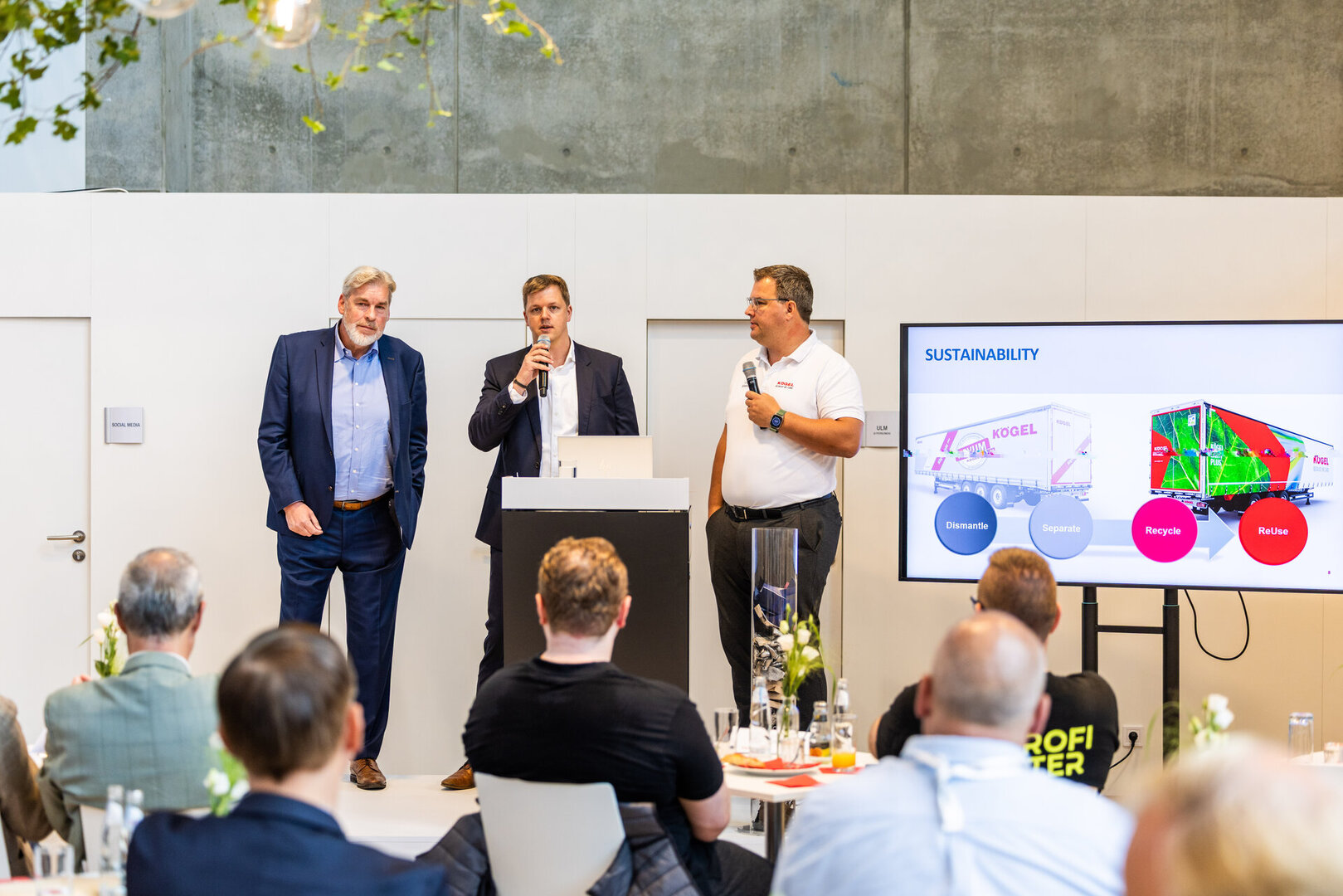
Kickoff at the IAA Transportation 2026: Sascha Hähnke (REMONDIS), André Zick (TSR) and Thore Bakker (Kögel) represent the pilot project
Thus, the project partners are examining the entire life cycle of a trailer: from material selection and manufacturing through usage phase to dismantling and recycling. The goal is to gain insights into how the principles of the circular economy can be incorporated as early as the development and manufacturing stages of new trailers.
As much recycled content as possible
The first phase of the project focuses on the use of post-consumer materials to manufacture a new trailer. Over the next one to two years, the three project partners aim to develop a vehicle that contains the highest possible proportion of recycled materials. The goal is to investigate which materials and components from end-of-life trailers can technically be used in the production of a new vehicle.
“This is a pilot project,” explained Sascha Hähnke, managing director of REMONDIS Sustainable Services GmbH. “It is, however, more about showing that we don’t always have to use new materials in production. We can also recover materials from used raw materials and then recycle them for reuse. The quality of a future trailer here should be just as good as a vehicle produced using virgin raw materials.”
In addition to the technical possibilities, the project partners are also examining the impact on the supply of raw materials. The goal is to investigate the potential that recycled raw materials offer for more resilient supply chains and, in the long term, for a more stable supply of raw materials. Suppliers are also being involved in this process to assess technical requirements and potential applications throughout the supply chain.
“We believe that there is a huge potential here,” commented André Zick, business development manager at TSR Resource GmbH & Co. KG. “And we are convinced that our products can already be used as a substitute for virgin raw materials in trailer manufacturing today.”
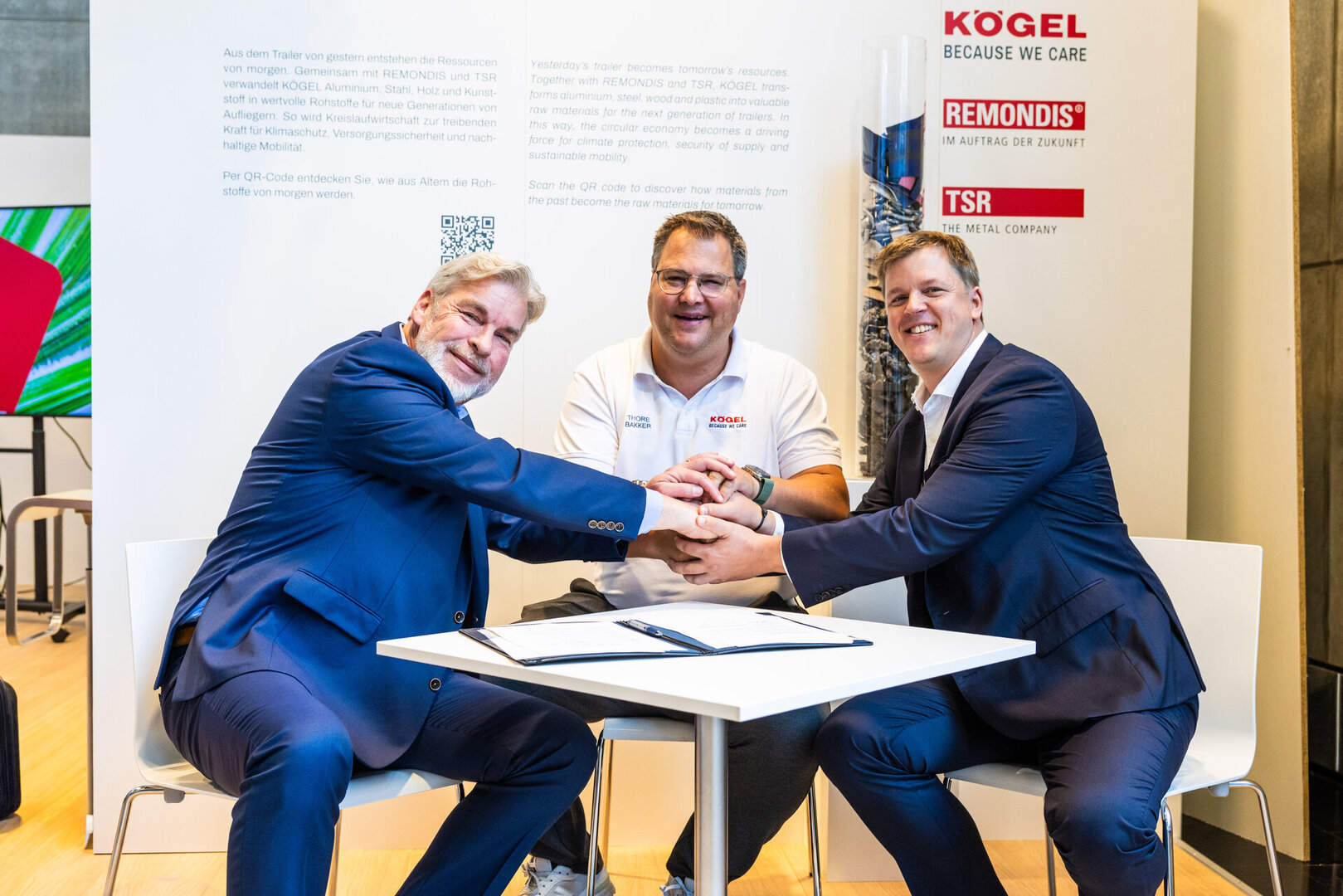
The three partners share a common goal: a closed material life cycle where the raw material content of end-of-life trailers can be used to produce the next generation of trailers.
End-of-life trailer provides insights
To gain insights into the material composition and recyclability of an end-of-life vehicle, a Kögel LIGHT PLUS with a total weight of 5,960 kilograms was completely dismantled by TSR. The components were then analysed and sorted into individual material groups. Steel accounted for about half of the total weight, aluminium for about one-fifth, and old wood for about twelve percent.
This detailed dismantling allows TSR to determine the trailer’s composition more precisely and to derive requirements for the subsequent recycling processes. Only through complete disassembly it can be determined which materials can be recovered, in what form, and of what quality.
At the same time, the analysis provides insights into how the eventual dismantling and recovery of materials can be taken into account as early as the planning and design stages of a trailer.
Recycled raw materials back into vehicle production
The second part of the project builds on these findings. Here, the partners aim to determine the technical and economic conditions under which the recovered materials can be reused in the manufacture of trailers.
From the project partners’ perspective, the dismantling results to date indicate significant potential for recovering recyclable materials. A key prerequisite for this is separating materials by type as thoroughly as possible. The better the different materials can be separated from one another, the higher the quality of the recycled raw materials obtained from them, and the lower the losses during further processing.
In addition to technical feasibility, the study will also examine available quantities, necessary return processes, and the economic viability of the approach.
A closed-loop material cycle
For Kögel, this collaboration is also an integral part of the company’s “Because we care” philosophy. The focus is not merely on recycling an end-of-life vehicle. Rather, the key question is how to recover its raw materials as fully as possible and use them in new products. “It is our vision to present a completed trailer in the next one to two years,” said Thore Bakker, CSO at Kögel. “Each vision begins by taking that first step. What is important here is to take action and to pave the way forward with concrete projects.”
Image credits: © TSR